CHOICE IS AN ILLUSION
EDU DDA Apr. 20, 2026
Summary: Officials from the UAE were in DC for the IMF and reportedly spoke to UST about some USD, according to WSJ. The talks centered on opening a dollar swap line which signals a growing chance of monetary stress through a critical redistribution point. The whole point of the exercise further reinforces how Dubai and the UAE have already made their choice about global money. Contrary to the usual suspects trying to make this about China and CNY taking down the eurodollar, any choices to be made were made a very long time ago.
POSSIBLE DOLLAR SWAPS FOR A VERY REAL GROWING DOLLAR SHOCK
Will the Iran conflict spell the beginning of the end for dollar dominance? Let me answer that question straight away with an emphatic “no.” If anything, those who have been agitating for dollar doom have already been at it for a very long time and getting no closer to their predetermined preferred outcome. You should already be skeptical for that reason alone.
Some of that bias comes via honest means, the disgust over government debts and abuse. Those two go hand in hand. The bigger any authority gets to be the more its hands will swell with heaviness. Lord Acton and all that. Others are just selling you, or trying to, the absolutely perfect remedy for the end of the dollar era (Bitcoin still has a large component of this).
There are serious monetary matters already brewing in relation to the current Middle East combat. None of them will lead to reserve currency replacement. Those who claim otherwise never seem to grasp what a reserve currency is or what it has to do. There are minimum requirements which have to be met which are non-negotiable.
It’s the inability to surmount them which explains the eurodollar’s continued dominance.
The latest bout of misdirection and mistake derives from Dubai, specifically, with the UAE as its acting legal overlord. Officials from the emirates were in DC for IMF and according to WSJ were at the UST seeking a memorandum about swaps.
Dollar swaps.
I explained what all this means and where it is coming from on YT today. Here, we are diving deeper into the background because this is a topic that comes up far too often. And the reason it does is that no one ever gives a second thought to the reality of a reserve currency, from mechanics to operation. There are simply way too many mistaken assumptions, starting with a petrodollar that is, at most, a subset of the eurodollar but in truth doesn’t actually exist.
Definitely not as some meaningful global contributor.
The Dubai/UAE matter isn’t a looming catastrophe, but the downside to dollar interruption is a real threat, one which grows each day the oil doesn’t flow and the eurodollars don’t get renewed..
Petrowhat?
On March 26, 2018, Chinese authorities began allowing seven different grades of crude oil to be traded on Shanghai’s International Energy Exchange. Since this specific marketplace fell under the rules of one of China’s larger Free Trade Zones, special areas within the Communist country which had been set up because even the Communists know that Communism doesn’t create wealth, domestic Chinese buyers and speculators would be able to directly transact with foreign speculators and sellers.
More importantly, the currency they’d begun to use for settlement was China’s renminbi (RMB), not dollars.
This “petroyuan” was purported to have been styled similarly to the so-called petrodollar and thus was seen as more than simply a product of enterprise evolution inside the dense Chinese bubble. Graphic headlines populated the media both East and West, many of them predicting the dollar’s doom.
…JUST THREE MONTHS LATER
The day before the oil contract trading went live, on March 25, UBS published a white paper on the topic. In the rush to be first to extol its virtues, the Swiss bank researchers wrote:
This will have two principal effects: increased demand for RMB assets and a switch out of the USD for trading purposes, which will likely undermine the United States' dominant role in the global economy and create a sea change in global asset allocation to China's financial markets.
The theory goes like this: by talking up the incentives to doing business directly with China, including, perhaps, a little more soft extortion along the lines of its Belt and Road Initiative, oil producers would agree to be paid in local Chinese currency. That would allow them to buy more goods directly from China or invest the proceeds there until they were ready without having to confront the difficulties presented by using the dollar.
For a time in 2018, there was so much salivating over China’s big move it had grown downright obnoxious. Even the venerable and usually dependable Mises Institute chimed in for another slap to poor old dollar’s reportedly tenuous fate. Writing in January 2018, in anticipation of the grand Chinese oil masterstroke (which had to be delayed several times and for several months), Alasdair Macleod piled on:
This might seem a frivolous question, while the dollar still retains its might, and is universally accepted in preference to other, less stable fiat currencies. However, it is becoming clear, at least to independent monetary observers, that in 2018 the dollar’s primacy will be challenged by the yuan as the pricing medium for energy and other key industrial commodities.
If anything, the dollar is as popular as ever - including for commodities – even as it continues to make the rest of the world miserable for it.
Theories can be fine to work from if they are legitimately grounded in on-the-ground facts. Where money and finance have been concerned, there’s probably never been such a huge divide.
Right from the start, China’s currency isn’t fully convertible in the most comprehensive sense, which means that once you have RMB in your hands you don’t actually have RMB in your hands. The Chinese government is notoriously inviting for those who want to move cash or product in, but equally if not more stringent for anyone even thinking about taking cash out.
RMB is therefore of limited use, a fact of monetary life China isn’t going to change anytime soon (they certainly haven’t yet). Which, if you understand the nature of global reserve currencies, would definitively rule out RMB as one even if the PBOC’s involuntarily ultra-tight grip on supply hadn’t already done so a long time before.
What everyone had taken for granted, before ever thinking seriously about the petroyuan, was how the dollar was assured to fall. It’s always going to fall. Money printing, political will, Biden, Trump, sanctions, war, something.
We’ve seen this countless times over the last dozen years. In reality, the Shanghai oil contracts are doing quite well, you might even say they’re thriving. China has been able to develop a decent (though questions persist) market for this financial product.
It was never meant as even a small piece, let alone the key piece, which would have allowed the world to dethrone the dollar, RMB first. That’s just other commentators hyping up another innocuous method the Chinese have to come up with in order to try and alleviate the ever-present (euro)dollar pressures they continuously face.
The hype is easy and easily packaged for sale; understanding what’s really behind the dollar obviously isn’t.
Reserve your reservations
Everyone knows about August 15, 1971; or, at the very least, they’ve probably heard that something important happened regarding the introduction of a fiat money standard and then the consequences of it. The term, fiat money, is conventionally taken to mean something it hasn’t been. By and large, we’re supposed to think about it as if the government was set free to be able to print money no longer tethered to any commodity constraint or public impediment (convertibility).
This, then, would presume that government’s central bank as the main engine behind reckless money printing and inflation as has been constantly asserted all the years since.
Neither of these are true.
How had inflationary currency already stricken the American economy if fiat money wouldn’t be unleashed until August 15, 1971? The answer is very easy in the fact that six years, by then, of serious inflation (which would only get worse) had meant other “money printing” unrelated to this later interpretation of events. Something else was already going on.
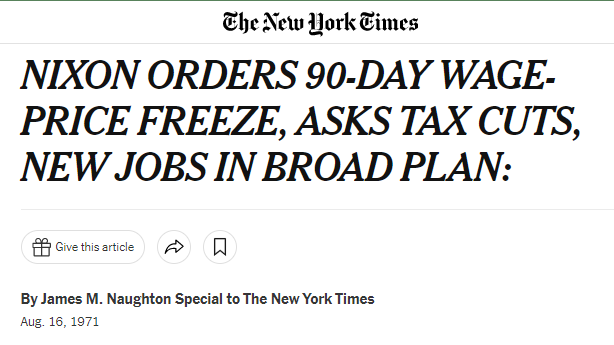
Nixon’s actual agenda had less to do with gold than many today are led to believe; he instead was counting on central planning control (wage and price boards) of the sort which made Mao Zedong red(der) with envy. The dollar’s gold convertibility was thrown in as an afterthought, a random dart thrown at the board – as evidenced by the fact no one involved in Nixon’s bold (and incredibly facetious) agenda had bothered to tell the Fed about this part of the plan.
Monetary policymakers had their own set of problems. At the end of July 1971, the FOMC Memorandum of Discussion recorded one such discussion which was characteristically too brief and left to table:
A number of members were dissatisfied with the present procedure of placing main emphasis on rates of growth of the monetary aggregates or on levels of the Federal funds rate, and some had come to believe that the directive should emphasize member bank reserves–the one magnitude which the Desk could control more or less directly.
In private, “monetary” policymakers were drawn into discussing a drastic change to material operations, core operations, in the way the central bank acted, as a central bank, because they figured out, six years of inflation, they were having trouble controlling or even influencing money aggregates. Or just plain money.
What do you do if you are, or claim to be, a central bank and you can no longer control or exert sufficient influence on money? Honestly, you’d have to conclude you were no longer a central bank. This is the actual deduction which would echo through fifty-plus further years of history, all these QEs later.
The Fed would have to take charge over only what it realistically could, bank reserves, already having been warned this probably wouldn’t be sufficient, either. The relationship between bank reserves and financial activities had likewise broken down, as had already the traditional correlation between all “base money” (as contained in something like M1) and economic aggregates like spending and prices.


To certain central bankers, the only way out of this Kafkaesque nightmare was to reinvent a central bank as something that is not a central bank. The Fed could only control what it could control, but if it could make the world believe that what it controlled was the only important part, then whether what it actually controlled was ever useful on a basic and technical level might not matter.
This expectations-based policy flipped everything upside down; the fiat money wasn’t printed by the Fed nor anyone in the government and hadn’t been long before the system even approached August 1971. The idea, on the contrary, was that unable to understand let alone measure and control effective money, the Fed would, again, control what it would control (bank reserves and later the federal funds rate) which would then signal to banks who then sorted out the messy monetary details central bankers couldn’t make much sense of.
In academic terms, this had meant monetary policy had been taken out of official hands, changed from “rules based” to “discretionary” largely by default. Alan Greenspan much later admitted to it because, he said, there was no other choice. Speaking at Stanford University in September 1997, the “maestro” said:
Policy rules, at least in a general way, presume some understanding of how economic forces work. Moreover, in effect, they anticipate that key causal connections observed in the past will remain fixed over time, or evolve only very slowly…Another premise behind many rule-based policy prescriptions, however, is that our knowledge of the full workings of the system is quite limited, so that attempts to improve on the results of policy rules will, on average, only make matters worse.
Thus, the Great Inflation and what the FOMC was actually talking about in 1971; following their traditional monetary rules had made matters worse because, in truth, no one had any idea what banks were doing in effective money. Not that the Fed had printed the money, or kept rates in the wrong place, rather because the private, now-global monetary system was already its own fiat consisting of these very, very different formats (eurodollars, repo, derivatives like currency swaps, etc.)
Greenspan would further clarify how, “by late 1982, M1 was de-emphasized and policy decisions per force became more discretionary” which only at first had incorporated the broader M2 aggregate as one factor among many others then advising central bank positions. And that was only until the late eighties, maybe early nineties when it had become very clear M2 (specifically its calculated velocity) no longer helped much at all, either, obsoleted by an expanding assortment of “financial products” (as Greenspan would say in 2000).
But – and there was always this “but” lurking in the shadows – by letting the banking system act as the monetary engine, the fiat money printer, and assuming it could be controlled or at minimum predictably influenced by “discretionary” expectations policy, the dangerous downside was logically obvious the entire time.
What happens if the fiat conjured by private global banks ends up going awry, really awry? Not just inflation, too much as in the seventies, but possible, shockingly maybe inevitably too little.
The real star of the show
Robert Solomon wasn’t just a faceless bureaucrat, one of the thousands scattered about at any given time buried within one and all of these agencies. He was the Fed’s chief international monetary analyst and negotiator, a man well-versed in what we call today the financial plumbing. He saw very early on the drawbacks of Bretton Woods particularly in the fifties as the global economy became far more global far more rapidly than previously thought possible.
In May 1984, the Federal Reserve Bank of Boston held the 28th conference in its symposium series, dating back to June 1969 (Jackson Hole isn’t the only regular symposium among the branches), in of all places Bretton Woods, NH. The topic was the fortieth anniversary of that monetary agreement and the status of the world just a few years after it was gone.
Presenting to that audience was, among several noteworthy participants, both Robert Triffin and Robert Solomon. The former’s presentation was geared more toward a relatively new development in the international monetary scheme – the European Monetary System, or EMS. Created in 1979, its purpose was, as Triffin said, to reduce European members’ dependence on “the vagaries of the dollar.”
That was an interesting phrase to use in 1984, for it echoed one that he, Solomon, and so many others had used in the late sixties, and later in describing after-the-fact the monetary circumstances of the latter sixties. Solomon had said in complimenting Triffin:
And as Robert [Triffin] also pointed out, the supply of new reserves was haphazard, depending on the vagaries of gold production (or that part of it that found its way into official reserves) and changes in the U.S. balance of payments. The agreement to establish Special Drawing Rights was designed to correct this flaw in the Bretton Woods arrangements. To be more precise, SDRs were a necessary, but not a sufficient, condition for dealing with the unstable supply of world reserves.
Others at the later Bretton Woods gathering were more precise. The breakdown of the postwar monetary order fell along the lines of liquidity and international mechanics, the sort of modern needs that gold was ill-suited to meet.
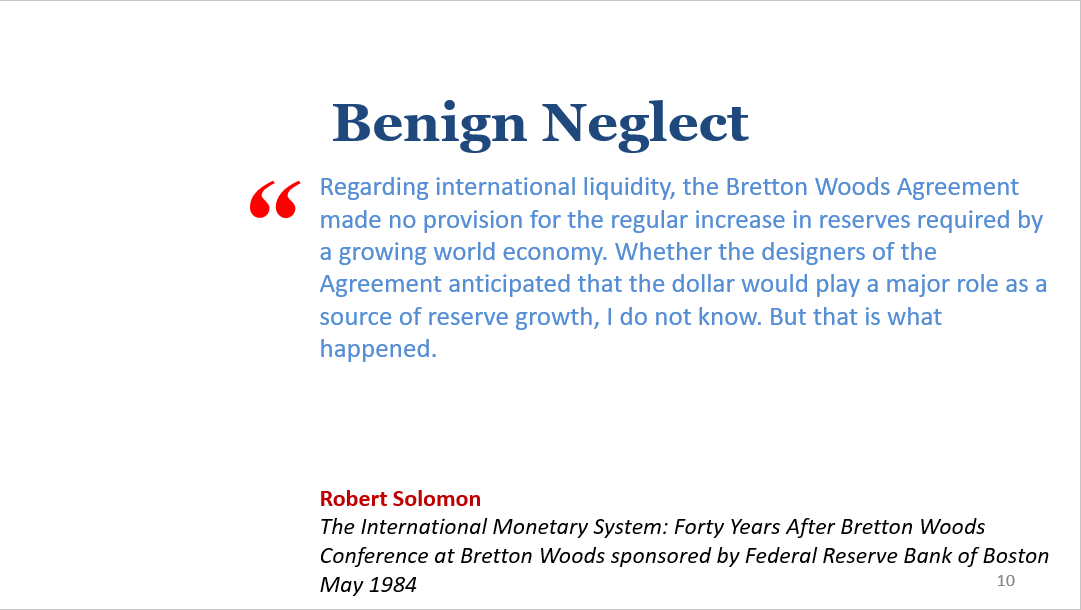
Robert Roosa, who was Treasury Undersecretary for Monetary Affairs for the Kennedy/Johnson administrations a few years before Volcker, recounted the many official “improvisations” that were tried as ad hoc reforms for Bretton Woods’ more glaring flaws; not just the London Gold Pool but also a “ring of swaps” where both the Federal Reserve and US Treasury held standing credit agreements to swap currencies (really provide exchange cover) with as many as twelve other central banks, and then what was a precursor to the Dim Sum bond, a US obligation floated offshore denominated in foreign currency.
Those were all serious attempts to address the serious systemic shortcomings, but all for naught because in truth they were in no way serious enough. As Roosa stated in 1984, the ultimate answer came from way outside the official circle.
But this combination of improvisations could not cope with, and indeed may have contributed to, the enormous expansion in markets for U.S. dollars offshore, and the new networks of interbank relations that made possible the creation of additional supplies of dollars outside the United States and beyond the control of the Federal Reserve. The ‘offshore’ currency markets soon became securities markets and, spurred by the U.S. effort to maintain control over capital exports from the United States, markets in Eurodollar securities (where the interest would not be subject to U.S. withholding taxes) flourished.
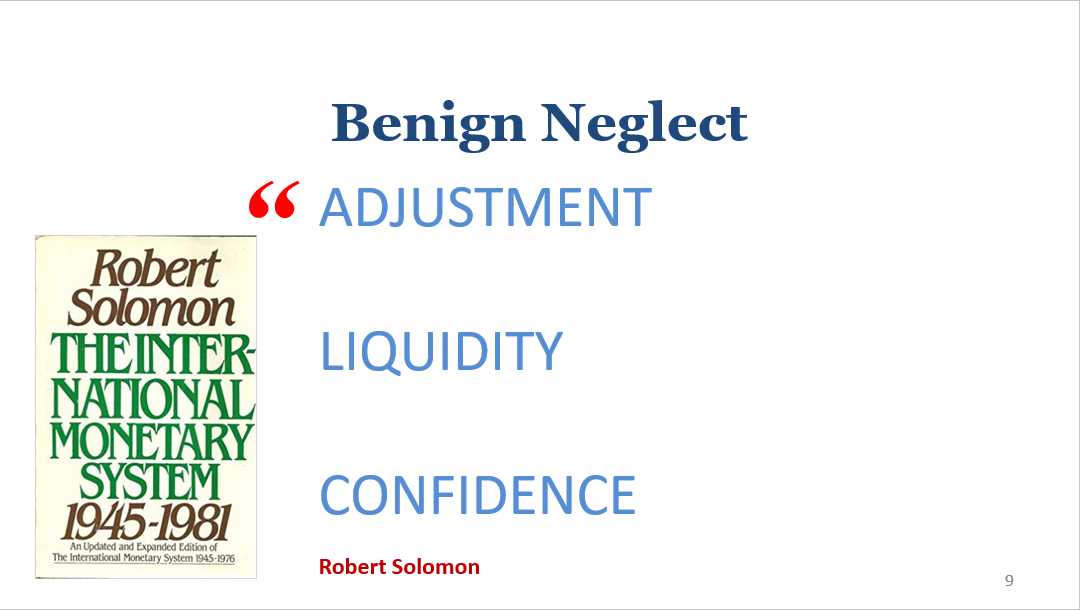
Solomon recalled, “We used to talk in the 1960s of three elements of the system: adjustment, liquidity, and confidence.” Far too much of the official reform effort toward the end of the Bretton Woods system was aimed only at the last of those three elements.
And yet, what good is confidence when the system has defined needs? I’ll put it another way; while officials were busy trying to maintain confidence in the old way, the system itself was forced by necessity (the mother) to invent the means to its own ends without waiting for officials to be successful or be proved otherwise. That’s ultimately what happened to the SDR’s, they were beaten to the punch by the eurodollar. The IMF came up with the former in 1969, while the latter had been in operation for maybe fifteen years already by then, oftentimes augmented by official actions even if officials didn’t know that was what they were doing (the “ring of swaps”, for one).
The ragged end of Bretton Woods, the real story rather than the single final act undertaken in August 1971, is both a cautionary as well as opportunistic tale. We are conditioned to believe that it is governments who set all the monetary rules, but in this case it was the opposite. Official action is no prerequisite no matter how many times the orthodox textbook repeats the canard that central banks are essential (as well as central) to monetary operation. They just aren’t.
This misconception is a huge part of our current problem. I’ve spent countless hours researching the history of the eurodollar as well as the end of Bretton Woods (as the two are intricately related) and what amazes me the most is that up until about 1984 these concepts were very well understood, discussed openly and forthrightly. And then…nothing. It’s as if the eurodollar fell off the face of the earth, at least in official writing and study thrown down the memory hole of Orwell fame.
We know, of course, that didn’t actually happen. The eurodollar became larger, stranger, and ever more integral to the manifestation of an international economy despite the blackout. It supplied the liquidity and adjustment mechanics the system required (and solved the confidence issue on its own) while for years policymakers dithered here and there with unsurprisingly weak, and ultimately unsuccessful, “improvisations.”
Can China’s yuan do that? Any of it? Not remotely. What led to eurodollar dominance was as much its flexibility as anything. It could be molded, even reinvented to suit the needs of those seeking to mediate through it. CNY is at the total opposite end in terms of capabilities well before getting to liquidity and supply.
Even the focus on supply is wrong; you can have all the money in the world but if it just sits there, whether as tangible currency in a physical vault or languishing on banks’ balance sheets in ledger form, supply means nothing if it can’t move.
Which brings us right back to flexibility again, since the one follows from the other. This is why Bretton Woods failed and where eurodollars succeeded. The eurodollar’s replacement has to at least match those capacities.
A reserve currency is a medium through which almost anything anywhere can be translated into a common “language”, a standard monetary framework which makes finance and commerce seamless and efficient (very close to it). A true reserve must be widely available and widely acceptable.
Most focus is wrongly applied to “acceptable”, another mistaken assumption similar to the one about money supply. Very little though is given to how money can become so ubiquitous. It is truly a modern marvel that has gone thoroughly unnoticed for all the mainstream infatuation with central bank psychology which doesn’t even ask the question why a central bank would have to spend all its time on psychology.
The thing is, Dubai’s predicament isn’t stuck choosing between dollar and yuan, even assuming the latter was realistic. The UAE had already made the choice a long time ago. It has sought to become the Middle East’s top eurodollar center, to be to the Global South what the City of London had been to the developed world’s ascent to 20th century “miraculous” prosperity.
Dubai isn’t quite there, however, which means it is susceptible to growing pains of illiquidity. The dollar swap line with Treasury, should it come about, is a means to manage the possible downside to the oil (and tourism) problem. There are fewer commercial dollars flowing in to support the rest of the eurodollar financial infrastructure which has already been constructed.
How in the world would flipping to CNY right now help them? The only reason this “choice” is ever brought up is quite simply how simple dollar doomism “thinks” the world is. To those practicing it, a reserve currency is how we price oil.
Truly absurd.
Never was. Never will be. Petroyuan has been thriving for eight years and in all that time it has done nothing to dent the dollar because the dollar isn’t even the target.